
















|
To Shop For Fish By Anne DeMarco |
|
|
|
FAIR HAVEN __ I've had some crazy rides home. You can be out
there on flat water, and within 10 minutes, we've been in five footers,”
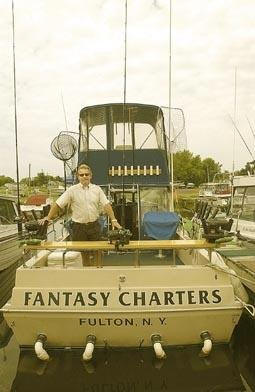
explained Fantasy Charters boat captain Clyde Keck. And frankly, that's what Keck loves about his job. Others, he has found, seem to envy his career. Everybody says that they think it's so easy. Guys, I work harder than I ever did when I was a fireman, said the captain, who for 23 years now has brought clients out to the deeps of Lake Ontario to shop for fish: the old fashioned way. There's something about being on the water in the sun all day that tires you out. |
| On an average day, he leaves his home in Fair Haven at 5 a.m., then gets the
equipment ready. After a day on the water, he cleans the catch, then the boat.
Common repairs to the boat include replacing frayed downrigger cables and engine
maintenance. He usually returns home around 4:30 p.m., if he's lucky. Then there
are phone messages to contend with and paperwork until 8 p.m. All in all, until the salmon move upstream in mid-September, he conducts 90 to 95 charters. Often that translates into working seven days a week. When summer's over, I go hunting. I love to hunt. As soon as September comes, I look forward to sitting in the tree, and I don't have to talk to anybody. I don't have to answer questions like, how deep? how far across? He paused. But if I think about it, that's part of the fun of it, he added. Seeing people have a new experience, seeing the look on their faces when they catch a fish. When the snow comes, wife, Loretta, and he vacation in Florida where he conducts sightseeing charters near West Palm Beach. However, as soon as the salmon come back to Lake Ontario in the spring, so do the Kecks. Keck has never been far from water or a rod and reel. I was very, very young when I first started fishing, he said, remembering the times spent at a camp his parents owned near the lake. Back then, we used to catch perch and bass. There was no such thing as trout and salmon. Those rarities were introduced to Lake Ontario in the early '70s, he said, when the hatchery was opened in Altmar. While the other fish are still caught close to shore, primarily his passengers want to go after the big ones, which are fond of the deeper, and therefore colder, water farther out. Temperature, he explained, is important when searching for brown trout or lake trout, chinook or coho salmon. Success is largely contingent on his skill of knowing where to go and when. A lot depends on water temperature, he said. These fish like mid-50 degree water. Also, there are some spots where current lanes come together, creating a drop in temperature. He knows where these are. There are two or three currents. They are like underwater rivers that flow from the Niagara River out to the St. Lawrence, explained Keck, adding that there are also 150- to 250-foot drop-offs in certain places, where the trout and salmon like to gather. For bait, Fantasy Charters supplies a lure that is stuffed with herring and spins, which imitates the alewives that twirl when near death. More popularly known as `Mooneyes`, the fish, which are of the herring family, are less abundant in the lake than they once were, due to the stocking of trout and salmon. Not indigenous to the Great Lakes, the alewives came first to Lake Ontario, expelled from the ballast of freighters, then spread throughout the remaining lakes. Much the same scenario applies to the zebra mussels, which feed on plankton thus filtering the water. The lake is getting much clearer because of them. Ten years ago, you couldn't see much more than three or five feet down. Now there are times you can see the bottom, Keck said. It changes the way we fish. Trout and salmon don't like bright lights, so we're catching them deeper than we used to. Another exotic immigrant, transported by freighters, has changed the fishing line used on Keck's 30-foot sports craft, known as the Fantasy. Because of the spring water flea, a microorganism that builds up on the line, Keck must use heavier and heavier gauge line as the summer goes on. They build up on the line - if you try reeling it up it locks. In the spring, we use a 12-pound test, later 15 to 18, then 30-pound or more, he said. They can't cling to the thicker line. No matter the gauge, an overly anxious fisherman will snap it trying to reel his catch in, Keck said. That turns the catch into a near-catch. Let the line go slack, and you'll lose the hook, Keck stated. Ninety percent land a fish when the fish gets tired, not until then.
|
|
| Note: Lake Life: To Shop For Fish By Anne DeMarco / The Citizen |
|